Sunday, March 24, 2013

The Week of March 20 in Review Preview


Well I threw out the entire normal idea for the week in review and we will start with a 2 part diatribe by Shawn and myself on DC.  A snippet follows - I hope to have a third part done to include some brief highlights of books I read. The DC thing is now just beyond the pale and has disheartened die DC fans like Shawn and I. 

Pre New 52 GA
The New 52 GA
Shawn: You covered all kinds of ground. Let me try picking some of your points apart, not because I want to disagree, but because they are worth closer scrutiny. We could debate Lemire, Azzarello, and Snyder’s current output, but they are not the problem. (Though there is a case to be made for taxing your talent too much. They cannot write everything.) DC Comics does not have a deep bench of proven and popular writers. Do they currently have a crop of gifted indie talent? Yes; however, one thing that has become apparent is that DC does not know how to cultivate young talent. Not in the current editorial climate at the very least.

As much as I dislike aspects of the New52 (*cough*where the hell is Wally West?! * cough*), I think the overall editorial vision of the relaunch fails not because of poor planning, but because they never truly owned their relaunch. What I mean by that is that DC has been largely reactionary since the launch. Eight months in? The first wave of axing and replacing began. Creative shifts have moved closer together and books come and go faster than you can keep track of. DC has little faith in their product, and unless it falls under the Bat-umbrella or are one of the very few exceptions, the editors are second-guessing their directions for their books. The overall complaints writers have had, whether they leave graciously or loudly, are the changes editors want to force on their books AFTER stories have been approved and the writers have written their stories

Comic Covers Sunday: Rom Spaceknight

I can't do Rom the Spaceknight toy justice.  In 1978 it was something completely different.   From another site, Taking a chance, in 1978 Parker Brothers came up with their answer to the Sci-Fi craze created by Star Wars...ROM The Space Knight.  At the time, he was one of the most hi-tech toys marketed.  If you've never seen the toy, I highly suggest going here and checking it out.  Toys, like comics, don't always age well and Rom has not.  But his comic had some spectacular covers.

Rom #2, January 1980
Pencils/inks: Al Milgrom The cover to the first issue was ok but not great.  But with issue 2 things started getting better.  Even if you didn't like the toy, you were compelled to look inside to see what was happening.


Rom #7, June 1980
Pencils/inks: Michael Golden
Ok, maybe Milgrom turned in his best work early!  But, for whatever the reason, he was replaced by non other than Michael Golden and the covers went from good to amazing.  As an added touch we even have a great example of a 70's cover dialogue box.  Sadly, I occasionally miss those.


Rom #12, November 1980
Pencils/omks: Michael Golden
You can make an argument that the cover is slightly generic but it made me buy the book and started a life long love of the Jack of Hearts.  I have to say, it's easy to collect all the appearances of a c-list hero that never appears.


Rom #15, February 1981

Pencils/inks: Bob Layton
I've never actually seen this cover!  Shooting someone on their wedding day certainly stands out on the stands.


Rom #16, March 1981
Pencils: Ed Hannigan

Inks: Al Milgrom
Yeah, it's a somewhat generic superhero battle cover but I still love it.  I am also gaining all sorts of new respect for Ed Hannigan.  He turned in a stack of great covers for World's Finest last week and continued to do the same for Rom. 


Oh well, that's it for this week.  Now go outside and enjoy the sun!


Saturday, March 23, 2013

Superior Spider-Man #006 – A Review


You can’t say this book doesn’t have a direction.  It’s a bit of a roller coaster ride that may turn your stomach, but you’ll be thrilled at the same time.

SPOILERS Follow.

Superior Spider-Man #006
Writer:  Dan Slott
Penciler:  Humberto Ramos
Inker:  Victor Olazaba
Color Art: Edgar Delgado
Letterer: VC’s Chris Eliopoulos
Publisher: Marvel
Price: $3.99 (including “FREE” digital copy which I sold on eBay for $3.00)

Mayor Jameson is pontificating in a press conference at City Hall about his newest proposal to mandate at least a 10-year sentence for any crime that was committed with a super-power.  He also wants to shut down the Raft, the prison especially created for super-villains or at least have it moved somewhere well clear of his jurisdiction, especially since people escape from it all the time.  While Phil (New Hobgoblin) Urich is video-taping the speech, we get an update that he’s barely making ends meet after payoffs to the Tinkerer and the old Hobgoblin.  Suddenly, his video camera cuts out along with all the other recording devices in the crowd when Speedball and Jester show up.  They’ve come to play a prank on Jameson, which everyone but his paid bodyguards enjoy.  However, their real sinister (and brilliant) purpose is identity theft on a massive scale when people go to their site to view the viral video.

Friday, March 22, 2013

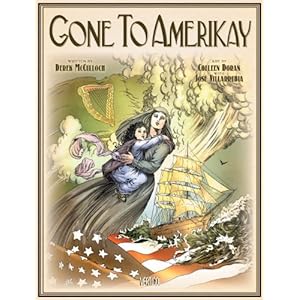
Gone to Amerikay

I remembered the ads for this Vertigo book when it came out, so when I saw it on sale at half off, I snapped it up.  Immigrant tales are always entertaining, if told well, and being Vertigo there was a better than average chance of it being told well.

And it is.  Looking at the cover you might think it's the standard story of a 19th century immigrant to America.  The harp is something of a giveaway that it's an Irish immigrant.  That story is there, but Derek McCulloch, Colleen Doran, and Jose Villarrubia present a bit of a twist.  In fact there's a little bit of the three different eras track that's currently being employed in Thor, though none of the characters in the three tracks here interact with one another, with the exception of one brief encounter.

The book follows a young woman who's an Irish immigrant to New York in 1870, a young man from Ireland who's in New York to become an actor and musician in 1960, and a wealthy Irish entertainment executive coming to New York in 2010 for business but also for his girlfriend/assistant to show him the story of one of his favorite songs and entertainers.  The executive is a big fan of the 1960 entertainer, who in turn wrote a famous song about the young woman from 1870.

There's really not much developed about the executive, other than that he's a fan of the entertainer and being given something of a gift by his assistant who tracked down information and locations to show him.  He's a cypher when it comes to personality, though he seems like a nice guy, at least superficially.  The real stories are of the young woman in 1870 and the entertainer in 1960.

The young woman came with her small daughter in the expectation that her husband would soon be joining them.  He had to stay behind in Ireland at the last minute in order to support an uncle who was accused of killing a British soldier.  She survives by doing laundry and has a brief stint as a maid in a wealthy fence's household, though that ends because she's too pretty and draws an attack by one of the rakes who frequent the place.  Ah, the days before sexual harrassment laws, when the victim got canned for the trouble caused by her attacker.  Oh, wait, you can still get canned for being too pretty if your employer thinks he might have trouble controlling himself.

Anyway, the husband never arrives in New York, though he was on his way.  Lies and cheating bring her into a relationship with a man who's on the lam from a mob boss, pretty much all the time.   That man ends up with his just desserts in time.  Our heroine winds up with his hidden wealth and some additional gratitude from the mob boss.

The concurrently told story of the entertainer in 1960 shows how he tries his hand at stage and song, has his heart broken in a relationship with a man who's sexually voracious, and who also steals credit for his songwriting.  In the midst of his despair over the double heartbreak there, he sees a ghost who tells him the story of our 1870 heroine and her husband.  This story becomes a new song that is very popular in its day, and is the song that is so important to the 2010 executive.  The ghost's story also leads the entertainer to find the ghost's daughter to let her know what really happened to her father, rather than the lie that was told to her and her mother.

It's a nice device that ties these three time lines together without any of the characters in each time ever interacting with any of the characters in the others, other than the brief meeting of the entertainer and the elderly woman who was a little girl in 1870.  There's a somewhat unnecessary touch when the girlfriend tells the executive how descendants of the victim of a muder and descendants of the murderer end up marrying, but it's such a small part of the story, taking only a few panels near the end, that it's not any real detriment to the story.  By far the 1870 and 1960 stories are the more engaging, but that's to be expected because the 2010 story is more or less passively relating those two stories and how they tie together rather than being a story unto itself.

Doran's art is lovely and evokes the times for each era in the story.  With Villarrubia's colors the poverty of the Irish neighborhoods in New York is stark.  With the excitement of the entertainment scene in New York in 1960 there's an exuberance.  In 2010 there's a wealth quite evident.  To a large extent this was one where the art drew me to the book and the story held up its end, rather than me following a writer.  As J Michael Straczynski said in his cover blurb, the story is both large in scope and intimate in details.  It develops the lives of its protagonists as well as showing eras, particularly in the 1870 and 1960 lines.  Take a little time and enjoy this one.

Thursday, March 21, 2013

Lee and Thomm discuss Wonder Woman: Blood Pt 2

In case you missed it, Thomm refuses to accept the fact that Lee is right. Again.


Thomm: Lee’s spent too much time around nuclear power and can’t get over that it hasn’t resulted in the development of a super power, so he’s channeled it into whining.

But back to our show. Azzarello’s Wonder Woman has writing that is far more clever than any I've seen in previous iterations of Wonder Woman. The various characters often employ sophisticated, knowing double entendres, not the juvenile sexually oriented, high school sort more often seen. These folks are referencing long histories with each other and the always biting interactions they have. Saying the dialog is akin to 100 Bullets isn't necessarily off, but it isn't a negative criticism, either, as far as I'm concerned. A level of sophistication not previously seen in Wonder Woman scribing isn't a bad thing.

Lee: Saying the writing is cleverer (a better word for us!) than other WW iterations isn’t a fair statement. If you say it’s better than the WW written in the past 5 yrs I would probably give it to you. But I would disagree with any story written before 2006. For example, Greg Rucka wrote WW from ’03-’06, Byrne before that, Messner-Loebs before that, and Perez before that. You can make the argument that the stories were more classical superhero stories but not that the writing is better.

This is one of DCs big three series. This is supposed to be a gateway book to world of superheroes. In terms of dialogue, there’s a difference between sophistication and making WW sound like a man. I expect Batman to be slightly dirty and grimy because of the movies. Batman is dark and brooding. I get it. Wonder Woman should be more in line with Superman as a bright, shiny book full of good natured people beating each other up. It’s Wonder Woman so I expect a certain amount of boobies but I don’t expect to see Hera running around naked issue after issue. If you want to make WW dark and grime and “sophisticated” then make it a Max title ala Marvel’s line and let people go crazy.

Thomm: I can’t comment on the Rucka, Byrne or Messner-Loebs iterations because I haven’t read them, but from your description it sounds a lot like the old style superhero dialog of days past. Having recently re-read some of the heralded books of the early ‘80s, I can’t lament the passing of that style of dialog. It’s stilted. It’s repetitive. Curiously, it’s written for single issues, which you think make Azzarello’s version appear better than it is even though his version is written more for a trade reading.

The Big Three issue is just dumbfounding to me. Diana is a kick ass warrior from an island composed almost entirely of warriors. Why wouldn’t she “sound like a man?” She ought to sound like a jet fighter pilot who is tops in her field of battle. She is one of the best warriors in her culture, if not the best. She surely shouldn’t talk like Superman, a guy who was raised to be a Boy Scout by his doting parents in the idyllic agrarian middle America, a sort of Jeffersonian paradise (if he’d ever gotten around to freeing the slaves without bankrupting his estate).

Lee: There’s two issues here again. First: Dialogue. Some of it was fine and some of it wasn’t. If you want Diana to sound like a jet fighter pilot, I am ok with that. I would argue that there was an inconsistency in her dialogue. Sometimes she was a pilot and sometimes she was a normal person.

The larger point I was trying to make with my Big Three comment was that this should be tamer, or less edgy, than it is. I consider WW one of those gateway books that should be accessible to everyone on all levels. This book is not that. The story is geared towards the edgy audience. It’s geared towards those that want real adult action, stories, and all that encompasses. WW is one of those books that any woman, or young girl, should be able to pick up and enjoy. Hera walking around naked all the time is not that.

Thomm: What? As far as Hera appearing naked, it’s not like we’re seeing any of her “naughty bits.” Those are always strategically obscured. We know she’s naked but we don’t see her naked. And why shouldn’t she be? She’s the goddess of women and motherhood. She’s extremely jealous of her husband’s infidelities. Why wouldn’t she walk proudly, nakedly, but for her peacock feather cloak? It shows her pride in her appearance and her feeling of superiority. It’s not like you’re objecting to Poseiden appearing as some sort of giant mutated fish or Hades as a boy with lit candles on his head. Neither of those are traditional depictions of those deities, either. I love the innovation in these portrayals. Hell, why not object to Apollo incinerating his muses or Ares appearing tired and weak? I think this level of creativity is a much better gateway than the same old lame portrayal of Diana that we’ve had for years now. From what I’m reading in Jim’s JLA reviews, Wonder Woman is just that lame in that book. The same old superhero approach is not going to bring in new readers.

Lee: You state the fact that Hera walks around naked as if every woman does that. I think that is far, far from reality. It makes the book very… sexist. That’s not the right word but it makes the book very much a male fantasy book. I would argue that it’s far more offensive to a larger portion of society than bad dialogue. I can give someone a book with some cheesy words and it’s ok. I can’t give everyone a book full of naked, no matter how “covered”, and get the same level of acceptance.  WW is a book that you should be able to give to an average person and have them enjoy.  If said person enjoys lots of violence and titillation then there are plenty of other books that I can start with.  

Thomm: But let’s get into the great characterizations of Ares, Apollo, Poseidon, and Hades. Ares is a broken god, weary of his interminable existence. Apollo is a cold manipulator. Poseidon is full of righteous rage, quickly diverted into amusement at Diana's manipulations, while Hades is petulant and vengeful at the same manipulations. These are fully fleshed characters, no less or more so than Diana.

Diana goes from her initial regal appearance with Zola to banter with Hermes to outrage at the disclosure of her true heritage. She also feels guilty for not being present when Hera transforms her mother and the warriors of Paradise Island. She's quick witted enough to alter her plans when the confrontation with Hades and Poseidon doesn't go as planned, too. Deus ex machina she's not.

Lee: I have to admit that I liked the characterizations of all the Greek gods. It was interesting and they moved the story forward as needed. Although the presentation of Hades was very interesting and I’m not sure how close that was to the myths. But, it was different and I was willing to accept it. I really liked Ares as old and tired. I agree with you there. But, they were villains, or tertiary cast members. What about Zola? Remember her, in issue six she has SIX dialogue balloons, 3 of which have one word in them. She is the reason Diana is in this situation and she has no personality. That’s not true, she’s a brat with little to no social skills. If I replaced Zola with a singing sword or some other inanimate object would the story be any different? I think not.

Thomm: Again, I disagree. Zola’s very lack of discretion in sexual partners is a key mover in the story. It sets Hera after her in the first place. Her decision to grab onto Diana so that she’s returned to her farm with Diana in the confrontation with the centaurs is also important. Inanimate objects aren’t going to do either of those things. Yeah, she’s something of a cypher, but, again, this is not her book. I don’t want to spend significant time exploring her history in this first chapter. I want to know about Diana. We have lots of that. It even comes back around when Zola stays where Diana told her in London, but Diana has to come back to rescue her when the centaurs show up again. Zola did what she was told. She wasn’t a brat who continued to confront Diana without reason. She learned something in that first issue but still wound up in danger.

So, after having re-read the same issues that encompassed the trade Lee read I think we read two different books. I see a great start to what is a very literary endeavor. Lee sees something significantly divergent from the superhero history that the character has had. I think that’s akin to objecting to Miller’s The Dark Knight Returns because it wasn’t like what had come before. Not that Azzarello has reached that level. And I’ll grant that The Dark Knight Returns wasn’t set within the DCU proper, but its influence clearly altered the Batman character in the DCU.

Lee: I think we went in expecting different things. I freely admit that I had a bias in this. I wanted a superhero story that was just that. A superhero story that was still Wonder Woman and that I might be able to share with my little girls before they were 16. This wasn’t that.


In conclusion, I don't think that Thomm or I managed to change each others minds but hopefully we clarified our viewpoints for y'all.  If it reads choppy, well that's the trouble with trying to have a debate via email. 

Lee and Thomm discuss Wonder Woman: Blood Pt 1

Thomm: A week (or so depending on when he gets around to posting this) ago Lee reviewed the first trade of Azzarello's Wonder Woman and was disappointed. Reading his review I wondered if he was on to something when he said it had deficiencies that might not be so noticeable reading single issues as he found them in the trade. Unlike Jim, I keep my singles, at least for a while, so I went back to the first six issues and read them again.

I'm not seeing what Lee sees as deficiencies. Here's the main thrust of what Lee said:

"There were some great ideas such as the various children of Zeus. But, Azzarello managed to make it all seem… pedestrian? WW is on a mission to save the latest woman whom Zeus loved from Hera. And, she has the personality of a stone. Seriously, she could have been a crown, or sword, or some mythical treasure for the amount of personality she had. Azz reduced her to a plot device. The same could be said of Strife WWs sister; nothing more than a plot device. There are several points when the voices sounded like they belonged to characters from 100 Bullets instead of a Wonder Woman book."
Lee: WHOA WHOA WHOA! What’s going on here? If ya wanna discuss let’s discuss.

*Ding ding ding* Tonight’s main event. The Master of Mayhem. The Leader of the Pack. The Luscious Leeeee.

And in the other corner. The annoying Thomm!!!!  And the crowd roars. Now then were were we?

Thomm: Annoying only to Lee. Entirely correct to everyone else.  Just call me the Maryland Mauler.

I'm not seeing Diana as a plot device at all. The story jumps right in with her being an established person in the DCU. There's no back story set-up. Hermes sends Zola, the latest paramour of a now disappeared Zeus, into Diana's London apartment while Diana is asleep, saving Zola from a pair of centaurs Hera created to kill Zola. Diana immediately (after getting dressed) jumps into hero mode, returning to Zola's Virginia home to save Hermes from the centaurs, while also saving Zola who tagged along.

Lee: I agree completely. I should have been clear that I never believed Diana was a plot device. ZOLA was a plot device. She gets the story moving and that’s about all she does. She’s the ‘fair maiden in distress’ if you will and little else. I will say, at this point, Zola wasn’t annoying me. The first issue was set up and achieved its goal. I did like the first issue.

Thomm: Well, with that shift to Zola as the plot device, there’s less in dispute. At this point Zola is a plot device. She’s clearly impetuous and not particularly choosy about her sexual partners, but other than that we don’t know much about her.

In issues #2-4, the story goes on to a highly emotionally charged visit to Paradise Island, where Diana faced childhood bullying for her different origin and is now subject to disdain for bringing the male Hermes to the island.  Diana has an emotional reaction to her just revealed half-sister, Strife, exposing her actual parentage.

I don't see the lack of characterization in Strife, either. She's manipulative. In fact, that's the core of her power. She arrives at the island, and for no reason at all, deceives the warriors into fighting one another, resulting in several fatalities and a lot of injuries. She then reveals Zeus and Hippolyta as Diana's parents, knowing that Hera will then be aware and seek to exact revenge, which she does by turning Hippolyta to stone and all the warriors to snakes. Strife is full of malice, thinly veiled.

Lee: Let me point out, that in your description of issues #2-4 you don’t mention Zola. This is where I really started having trouble with her. She’s this ‘thing’ that Diana is supposed to be protecting. All this stuff is supposed to be happening because Zola is soooo important, yet she gets dropped for 3 issues. I think that’s bad story management. Not bad storytelling, but bad story (plot?) management.

Let’s look at the Strife character because I had trouble with her too. Let’s ask the basic question: Who is Strife? I ask it because she is supposed to be some sort of godling but I can’t really tell. I recognized Zeus (in name), Hera, Hermes, and Apollo. I don’t recognize Strife. Let’s call that a minor annoyance. So, the question becomes: what’s her motivation?

We have a scene in which she is talking with Hera but it isn’t clear if Hera sends her to Paradise Island or she just goes on her own. Her power is her power and some Amazons get killed. I’m fine with that. But, at the end of issue #2 she just announces that WW is the bastard child of Zeus. Again, why? There is no motivation of the character other than plot device.

Thomm: Well, you’re missing something in the reading of the dialog between Strife and Hera. Strife is clearly the daughter of Hera and Zeus. At this point, of all the children of Zeus that we see she’s the only one whose mother is Hera. I also think it’s clear that Hera doesn’t send her to Paradise Island. Hera has no idea that Diana is another of Zeus’s bastards until after Strife visits and proclaims it. As to Strife’s motivation, I’d have to say that her name sums it up neatly.

But back to Zola. She’s not dropped out altogether. She’s not important for a bit while we delve into what’s happened on Paradise Island after Diana left with Zola and Hermes, but then, neither is Hermes. They both show up in ongoing moments in the issues but aren’t the focus. In fact, it’s some of those moments that bring out more of Zola’s character. Regardless, though, I don’t have a lot of issue with Zola being a deus ex machine, particularly in Chapter 1 of a longer story. After all it’s not her book. It’s Diana’s book.

Lee: And here’s where reviewing trades is different from reviewing single issues. At this point, you and I are pretty much in agreement. Zola is a plot device but it is Diana’s book so I’m letting it ride. But, in another 2 issues, you’re going to see that Zola isn’t much better.

As for Strife, it depends on your level of acceptance. I re-read myself and it’s stated that she is the daughter of Hera-Zeus. The random decision to travel to Paradise Island still feels forced but it is keeping with her name. As a villain I wasn’t particularly impressed with her and as a lawful-evil ally she was kinda ho-hum too. For comparison, Deimos and Phobos, the Greek villains that Perez introduced in the last great WW reboot were far more interesting in a shorter time.

I guess it’s safe to say, through 4 issues we are still pretty much in agreement. But tomorrow, we discuss issues 5, 6, and more minor annoying points.

Wednesday, March 20, 2013

Image Previews for May

Lee: Image is getting more and more interesting every month. They have such a good blend of new material and trades that it’s hard to know what to get. The best part is that most of the material is really, really good.
Thomm: I think Image has the best selection, on a month to month basis, of any of the publishers right now. With Vertigo putting out less, Image is rising all the more in my interest, with Dark Horse a close second.

TEN GRAND 1
story J. Michael Straczynski
art / cover Ben Templesmith
32 Pages / FC / $2.99
Joe Fitzgerald was a mob enforcer until the day he met Laura, who convinced him to leave that world behind. Before quitting, Joe agreed to one last job, little realizing that the man he'd been sent to kill was deeply involved in demonlogy. He survived Joe's attempt and came after him, fatally wounding Joe and killing Laura. As he lay dying, an angelic force (who may or may not be what she appears) pointed out that where she is going, he can't follow, and where he is going, he wouldn't want her to follow. But if he will agree to work for them as a different kind of enforcer, they will bring him to life and keep on bringing him to life every time he is killed in a righteous cause. The reward: for those five minutes of death, he will be with Laura again. Would you endure an eternity of pain and death, dying over and over, to be with the woman you love for just five minutes each time you died? Most people might say no. But Joe Fitzgerald isn't most people.
Lee: Straczynski was kinda hit/miss for me until his Before Watchman series. It seems that he’s gotten some of his mojo back and I, for one, am happy to read it again. This certainly sounds interesting and with Templesmith on art I am sure it will look great. This is by far, the easiest pick of the month.
Thomm: I’m not so sure it’s the best pick of the month for Image, but it does look promising. My concerns with JMS over the years have been less about the quality of his work and more about his seeing it through to the end.

THE BOUNCE 1
written by Joe Casey
art and cover by David Messina
32 Pages / FC / $2.99
Meet the ultimate slacker superhero for the 21st Century! Jasper Jenkins is a super-head AND a super-hero! He's relatable AND reliable and he's embarking on the adventure of a lifetime! The sensational debut of the new feel-good hero of the decade! You can't afford to miss it!
Lee: This write up is terrible! The hero(?) makes me think of Speedball but I can’t believe Casey would write that. Casey’s ideas are too big and, actually, whacked out for something so straightforward. I like most of Casey’s stuff so my interest is piqued but I wish I had a better idea of what the series was actually about.
Thomm: Having read the first issue of Casey’s Sex, I find this to be the more interesting book than Ten Grand. I’m looking forward to seeing how Casey overcomes the inherent adversity between the inactivity of a super-head and the hyper-activity of a super-hero, embodied in one person.

AMERICA’S GOT POWERS 7 (of 7)
story Jonathan Ross
art / cover Bryan Hitch
32 Pages / FC / $2.99
Too many Americans with too many powers...so the government decides it's time to wipe them all out and start from scratch. Nobody ever said it would be easy.
Lee: It’s only taken a year to get 7 issues out. Did anyone make it to the end? Is it any wonder why I trade wait?
Thomm: Yeah, this is definitely trade material. I see Ross is employing what a friend and I called the Mexico Plan when we were in college 20 plus years ago. Kill ‘em all and start over. I suppose it’s really the Noah Plan.

COMEBACK TP
story Ed Brisson
art / cover Michael Walsh
136 Pages/ FC/ $14.99
Reconnect agents Mark and Seth go back in time to save people from their untimely demise – for a fee. But, when a rescue mission goes awry, both agents find themselves trapped in the past and on the run from both the FBI, who want to jail them, and their own employers who want to kill them to protect their own dark and deadly secrets. Collects COMEBACK 1-5, plus never-seen-before extras.
Lee: Then again the problem with trade waiting is you don’t remember all the series. Take this one for instance. I do not remember this at all. It sounds great and for $3/issue it’s not all that bad a deal.
Thomm: It’s a bit like buying just one chapter of a book, though. At only 5 issues you’re not getting far into the story, I’ll bet.
Lee: So I just looked this up because I can't believe I missed it and found out this was the story with the illegal time travel operation.  That's what we liked about this, "illegal time travel'.  That's a hook.  This writeup doesn't do the series concept justice. 


’68 JUNGLE JIM 2 (OF 4)
story Mark Kidwell
art / cover Jeff Zornow & Jay Fotos
32 Pages / FC / $3.99
The skies over Vietnam rain liquid fire as Brian Curliss, AKA Jungle Jim continues his epic quest to find the rotting, undead remains of Sergeant Jim Asher. Jim’s search carries him across the border into war-torn Cambodia, where the struggling occupants of an isolated French mission hold their own against hunger, madness and the ravenous dead.
In the dripping shadows of the rainforest, human life hangs on a hair trigger and to save himself and those who need him, Jim will have to face more than the living dead and swarms of vengeful Viet Cong… because here there be tigers.
Lee: IT’S JUNGLE JIM! We know him! He writes for us allllll the time. And check out that cover, wasn’t Jim saying something about heads on pikes just yesterday (several days ago by the time this actually sees print). I think Jim should get this and tell us how it is.
Thomm: Considering our Jungle Jim buys just about everything published I’m guessing he’s already ordered this series. With his affinity for heads on pikes this would rank up there with a monkey on the cover. Being set in the jungle, maybe he’ll get that in a future issue.

IN MUSIC 2
story Steve Niles
art / cover Tony Harris
22 Pages / C / $2.99
Al Capone is dead. Shot through the skull by Shaw’s cursed slug, the gangland legend lies dead before Eliot Ness could drag him to court on tax evasion. Shaw’s interference has uprooted history and now Ness wants it set straight. The shot also alerted Shaw’s enemies of his presence in Capone era Chicago, and they are coming for him. They took his skin last time. This time they'll have his eternal soul.
Lee: Zombies and gangsters, I guess it’s a new idea. Unfortunately I’ve been less and less thrilled with Niles output over the last year or so. Not that it’s bad, but not that it’s good either. It’s just not held my interest.
Thomm: Yeah, I tried out a Niles title a couple years ago and was underwhelmed. Besides, why would Ness be upset that Capone is dead? It’s not like he knows how history was supposed to go. As far as Ness would be concerned, a dead Capone is a good Capone.

DIA DE LOS MUERTOS 3story Alexander Grecian, Kurtis Wiebe and Joe Keatinge
art / cover Riley Rossmo
40 Pages / FC / Golden-Age Format / $4.99
Inspired by the Mexican Day of the Dead, artist extraordinaire, Riley Rossmo, interprets stories from three of today's top writers. From Kurtis Wiebe (Peter Panzerfaust) comes a heartbreaking love story--in this world or the next. Joe Keatinge (Glory, Hell Yeah) offers up Day of the Dead 3000. As Ultra Muertos falls at the hands of Mother Slaughter, his grandson takes over the mantle with a death wish for all-out apocalypse! And New York Times bestselling author Alexander Grecian (Proof) tells a tale of ghost children.
Lee: Jim sent the first issue to me and I am glad he did because I wasn’t getting it otherwise. Basically this is an anthology around the Mexican Day of the Dead. Rossmo’s art is the real draw here, but it looks like the writers are getting better as the issues progress. If you like Rossmo’s art then you will most likely enjoy this.
Thomm: I liked Rossmo’s work on Proof, and I have some fondness for anthologies. I may have to take a look at this when I hit the store today (writing on a Wednesday).

MINIATURE JESUS 2 (of 5)
story / art / cover Ted McKeever
24 Pages / BW / Golden-Age Format / $3.99
Critically acclaimed writer/artist Ted McKeever returns to the theater of the bizarre, as a small-town Pastor thinks the eight-inch Jesus that descended from a cross on the church's wall is the devil's work. Meanwhile, a recovering alcoholic's fractured reality battling his own demons is becoming all too literal.
Lee: When the phrase “theater of the bizarre” is combined with McKeever then you know it’s gonna be out there. McKeever’s last book, Mondo Bizarro, was a visual masterpiece but the story was bizarre. McKeever visited similar topics to this in his Metropol series which was excellent. I am sure this will be good.
Thomm: This raises an interesting question for me. When something out of the ordinary occurs a lot of people decide it’s either a work of god or a work of some demon. Who decides? In an omnipotent, omniscient theology is there a difference?

Thomm: I went into this figuring on The Bounce as my first choice, but now I’m looking at Dia de los Muertos and Miniature Jesus, too. Ten Grand might be more of a wait for the trade like Lee.
Lee:  I'm all over the map this month.  So much of this looks good I'm not sure which one I like the best.